Gel Filtration, ultrafiltration, and dialysis each have distinct strengths. Here is a practical guide to help you select the right approach for your workflow.
Sample preparation of macromolecules is one of the most routine tasks in laboratory work, and the method you choose has a direct impact on how quickly you get a clean, usable result. Whether you are removing salts after FPLC purification, exchanging buffers before a downstream assay, or gradually removing a denaturing agent to restore protein activity, three established methods cover most requirements: gel filtration, ultrafiltration, and dialysis. Each separates molecules based on size, but through different mechanisms and with different tradeoffs.
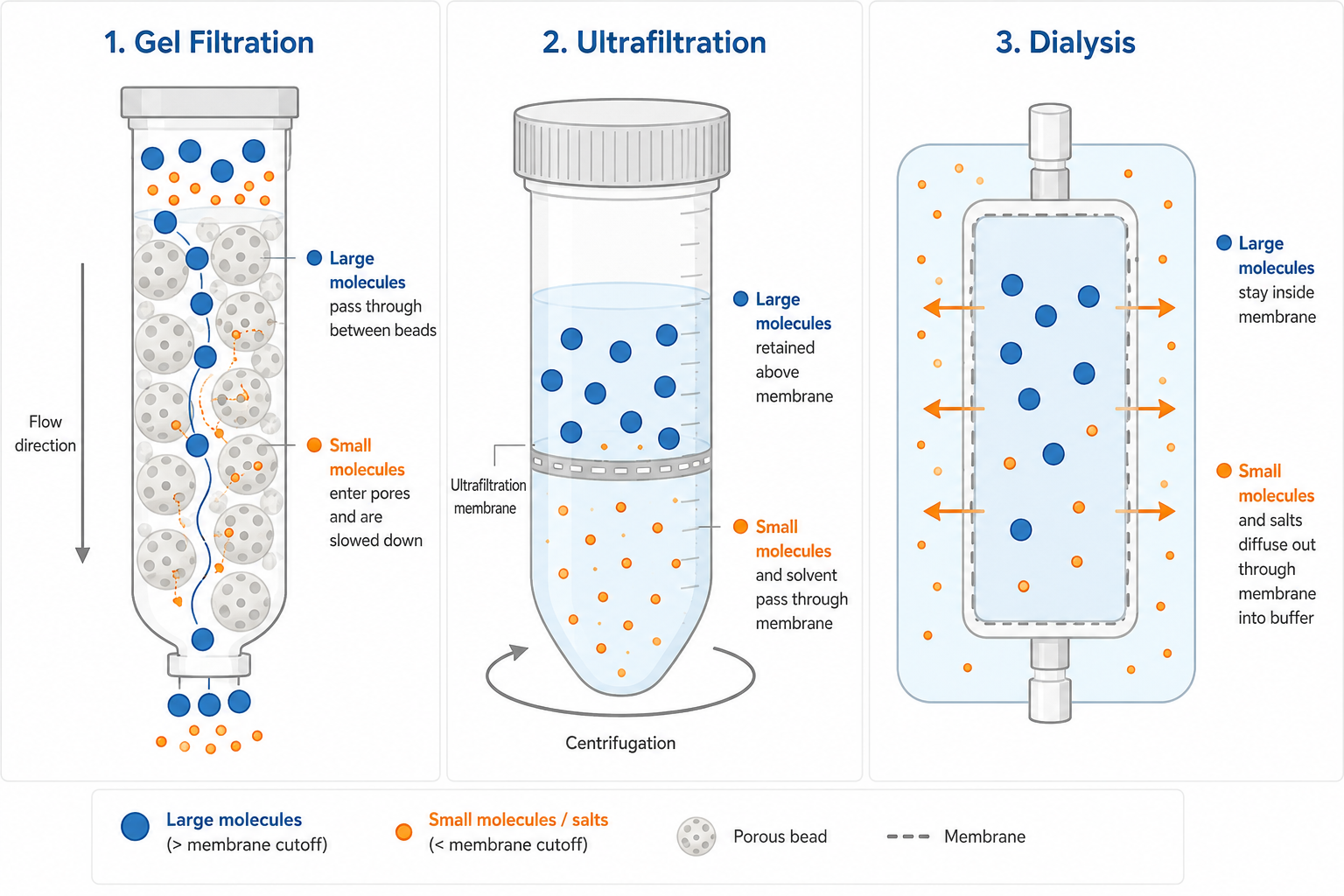
Gel Filtration is a non-absorptive chromatography method that separates molecules by size as they pass through a porous matrix packed into a column. Larger molecules cannot enter the matrix pores and travel through faster, while smaller molecules are slowed as they enter and exit the pores, eluting later. The result is size-based separation with no chemical interaction between sample and stationary phase.
It is a well-established method for desalting and the partial purification of protein solutions, with high sample recovery rates and straightforward handling. The main limitations are throughput and dilution. Because column length determines resolution, sample volume directly drives column size requirements. The sample is also diluted during the run, which often means a concentration step is needed afterward. High-throughput and automated workflows are difficult to implement with standard column-based gel filtration.
Ultrafiltration uses a semipermeable membrane to separate molecules by size. In centrifugal formats, the sample is spun to drive fluid through the membrane, retaining and concentrating larger molecules above while smaller molecules and solvents pass through. In tangential flow filtration (TFF), the sample is pumped across the membrane surface rather than through it, which reduces fouling and allows continuous recirculation of the retentate. Both approaches concentrate and desalt in the same step.
Centrifugal ultrafiltration is fast and requires only a standard laboratory centrifuge, making it practical for small to intermediate sample volumes. TFF formats such as cassette-based systems are better suited to larger starting volumes and workflows where the sample needs to be processed continuously without the membrane becoming blocked. A wide range of MWCO options is available across both formats, from 2,000 to 100,000 Da.
Dialysis is a diffusion-driven process. Small molecules and salts pass freely through a semipermeable membrane from a region of higher concentration toward lower concentration, while larger molecules such as proteins and nucleic acids are retained. The driving force is the concentration gradient between the sample and the surrounding dialysis buffer, and the process proceeds until equilibrium is reached.
It is the gentlest of the three methods, which makes it well suited to sensitive samples and applications where biological activity must be maintained. Gradual removal of denaturing agents such as urea, for example, allows proteins to refold correctly in a way that rapid concentration or column-based methods may not support.
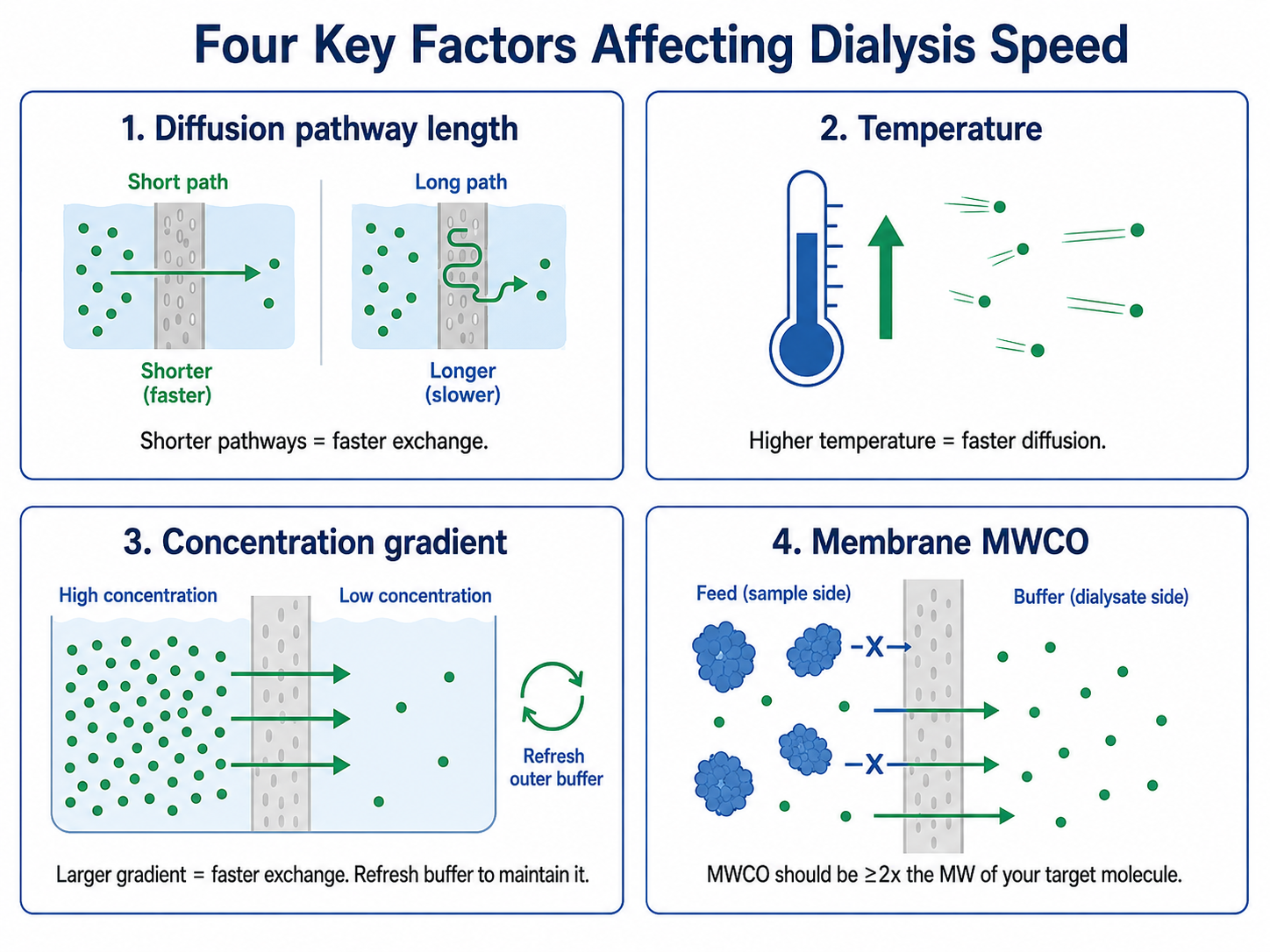
Several factors determine how quickly dialysis proceeds:
Diffusion pathway length — shorter pathways within the dialysis device lead to faster exchange. This is a key design variable and a reason why dedicated dialysis cartridges outperform dialysis tubing in most applications.
Temperature — higher temperatures increase the rate of diffusion, accelerating dialysis. The upper limit is determined by the thermal stability of your sample.
Concentration gradient — a larger difference between sample and buffer concentration drives faster exchange. Refreshing the dialysis buffer partway through maintains this gradient and significantly improves efficiency compared to a single long dialysis step.
Membrane MWCO — the cutoff should be at least double the molecular weight of the molecule you want to retain, and no more than half the molecular weight of the compound you want to remove. For non-globular molecules, preliminary testing is recommended.
Traditional dialysis tubing and cassette formats work well for single samples but can be slow and difficult to scale. Multi-well dialysis formats that fit standard 96-well and 48-well deep well plates allow large numbers of samples to be processed simultaneously, and can be integrated directly with automated liquid handling platforms, reducing hands-on time significantly.
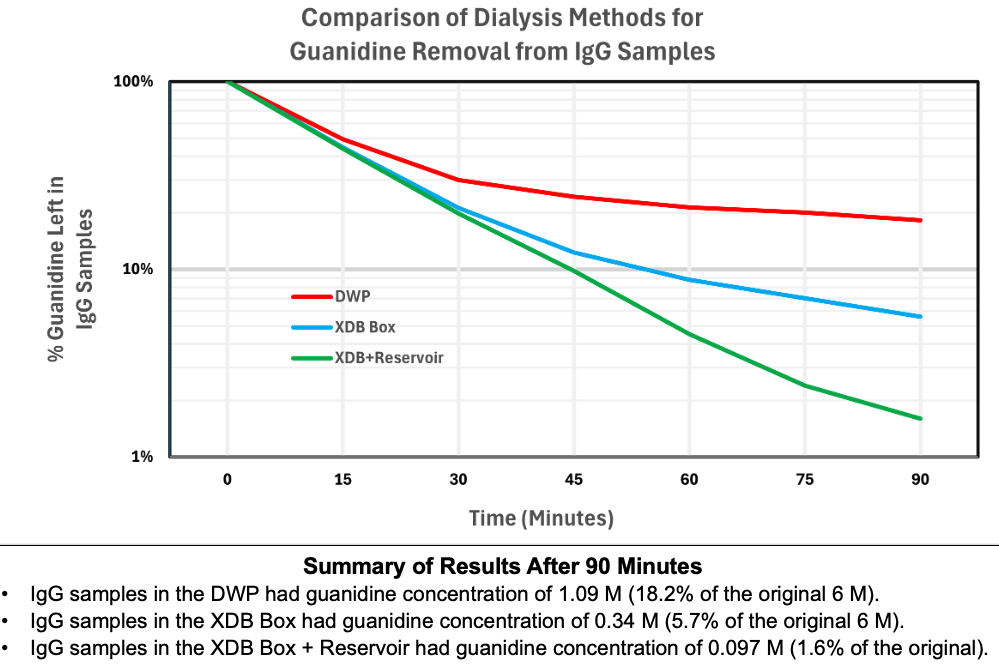
XDB Xpress Dialysis Box removes small molecules faster than conventional dialysis. In a direct comparison, the XDB Box with an external reservoir and peristaltic pump reduced guanidine concentration in IgG samples by over 98% in just 90 minutes—far outperforming standard dialysis plate (DWP) formats, which removed only 82% over the same period.
At a glance
A quick reference for selecting the right approach based on your sample type and workflow requirements.
| Gel Filtration | Ultrafiltration | Dialysis | |
|---|---|---|---|
| Separation principle | Size exclusion through porous matrix | Pressure or centrifuge-driven membrane filtration | Diffusion through semipermeable membrane |
| Concentrates sample | No (typically dilutes) | Yes | No |
| Desalting | Yes | Yes | Yes |
| Buffer exchange | Yes | Yes | Yes |
| Renaturation | Limited | Limited | Yes |
| Sample gentleness | High | Medium | High |
| Throughput | Low | Medium to high | Medium to high (multi-well formats) |
| Large volume capable | Limited | Yes (TFF formats) | Limited |
| Automation compatible | Limited | Limited | Yes (multi-well plate formats) |
| Equipment required | Column and FPLC or gravity | Centrifuge or TFF pump system | Standard pipette and plate |
Vivaproducts solutions
Vivaproducts offers solutions for ultrafiltration, tangential flow filtration, and dialysis workflows, with a range of formats, volumes, and membrane options to suit research and process development applications.
Available from 500 µL to 100 mL sample volumes with PES, Hydrosart, and CTA membrane options across a 2k to 100k Da MWCO range. Designed for fast concentration and buffer exchange with high protein recovery.
View VivaspinA next-generation plug-and-play TFF cassette for ultrafiltration and diafiltration of intermediate sample volumes up to 1 L. Designed for ease of use in R&D labs processing proteins, nanoparticles, nucleic acids, and viral vectors. Features a re-designed flow path with an expanded range of membrane materials and MWCOs.
View Vivaflow SUReady-to-use multi-well dialysis systems for 10 µL to 1 mL sample volumes in 96-well and 48-well formats. Compatible with automated liquid handling platforms and validated for protein, RNA, DNA, and clinical sample workflows.
View Xpress DialyzersOur application specialists can help you select the correct MWCO, membrane type, and device format for your specific sample and workflow requirements.